When an AI tool says "free", it can mean five different things. Some tools give a small allowance that renews every day. Others cap you per month, or for life. Some only offer a trial, and some have no free option at all. Knowing which pattern you are looking at tells you whether a free plan can support real work or only a quick test. The examples below were checked on official pages and help pages.
Pattern 1: a free plan with a daily allowance
Leonardo.ai gives free users a daily allowance of 150 tokens, and its help center explains that unused tokens do not accumulate, so what you do not use today is gone tomorrow. v0 states a limit of 7 messages per day on its Free plan. Bolt.new describes its Free plan as free forever with no card required, and lists a daily limit of 300,000 tokens plus a monthly limit of 1,000,000 tokens. Daily allowances suit regular light use, but they do not suit a big project that needs one long session.
Pattern 2: a free plan with a monthly or lifetime cap
Otter.ai's free Basic plan is listed as free with no time limit, with 300 transcription minutes per month shared across transcription types, and only 3 lifetime audio or video file imports. A lifetime cap is the most important detail to notice: once it is used, it does not renew.
Pattern 3: free, but with trade-offs you must read
On Leonardo.ai's pricing page the Free plan lists its creations as public, while paid plans list them as private. Whether that matters depends on what you generate. Read the visibility, model access and quality settings next to the price, not only the allowance.
Pattern 4: a trial, but no free plan
Jasper's pricing page lists two plans, Pro and Business, and does not offer a free plan. Pro includes a 7-day free trial, and Business requires contacting sales. A trial is useful for evaluating a tool, but it ends. Do not plan a long-term workflow around it.
Pattern 5: no free option
Midjourney's help center says that a limited trial is available on its niji journey mobile app, and that no free trial is currently available in Discord or on the midjourney.com website. Its plans are paid subscriptions.
A special case: free because it runs on your computer
Ollama runs models on your own machine at no cost. Its pricing page lists separate plans for cloud usage, which are not required for local use. Local tools trade a subscription for hardware: your computer's memory and GPU become the limit.
Seven questions to ask before relying on a free plan
Step 1 What is the unit of the limit?
Tokens, credits, messages, minutes and file imports are not comparable. Convert them to what you actually do, such as images, pages or meetings.
Step 2 Does it renew, and how?
Daily, weekly, monthly or never. Adobe's help center says credits for free plans are allocated on first use and expire one month after allocation.
Step 3 Do unused amounts roll over?
Leonardo's daily tokens do not accumulate. Check the same point for any tool you plan to depend on.
Step 4 Is your work private?
Check whether outputs are public on the free tier.
Step 5 Which models or features are included?
A free plan may exclude the best models or the exports you need.
Step 6 Is it a plan or a trial?
A trial that expires is not a free plan.
Step 7 What happens when you reach the limit?
You may be blocked until the next period, or be offered extra credits. Decide in advance what you will do.
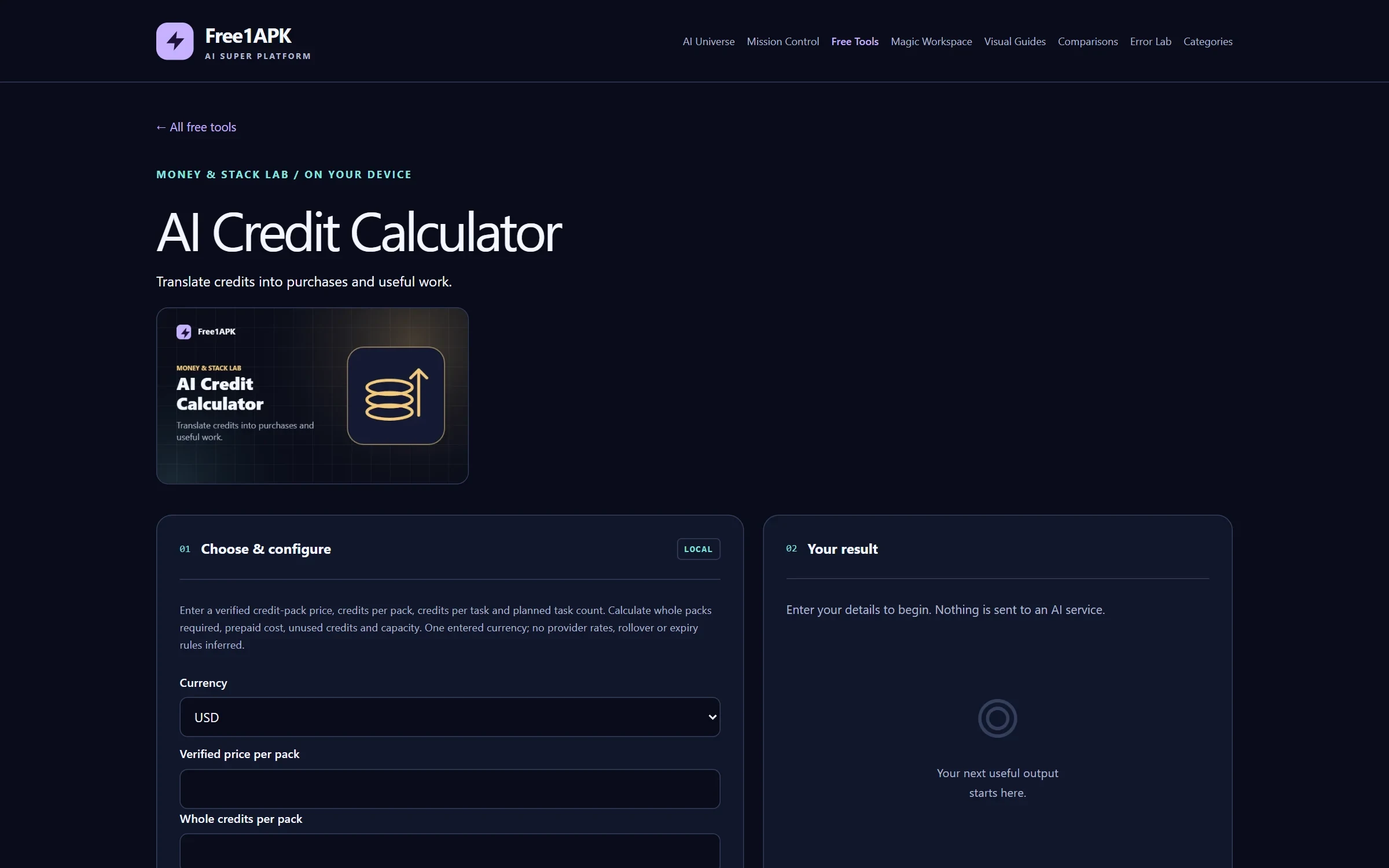
AI Credit Calculator: packs, tasks and leftovers
AI Subscription Calculator: the total cost of your stack
Guide: plan AI subscription costs with your own numbers
Leonardo.Ai help center: tokens FAQ
Checked on 2026-11-22 against each tool's official pricing or help page. Provider documentation, plan names and limits change, so confirm anything that affects a purchase or a production system on the official page before you rely on it.